5 January 2026
The Moment When Heaven Splits Open. The Baptism of Christ in Iconography
The icon of the Baptism of the Lord does not show baptism in the sense in which the Gospel narrative presents it. It does not tell a story; it condenses theology. In a single image it gathers the moment when heaven opens, matter is sanctified, chaos gives way, and the cosmos — from the angels to the River Jordan — recognizes its Creator. Every detail of this scene is a precise sentence spoken in image. If we look carefully, we do not see an episode from the life of Jesus, but an icon of new creation.
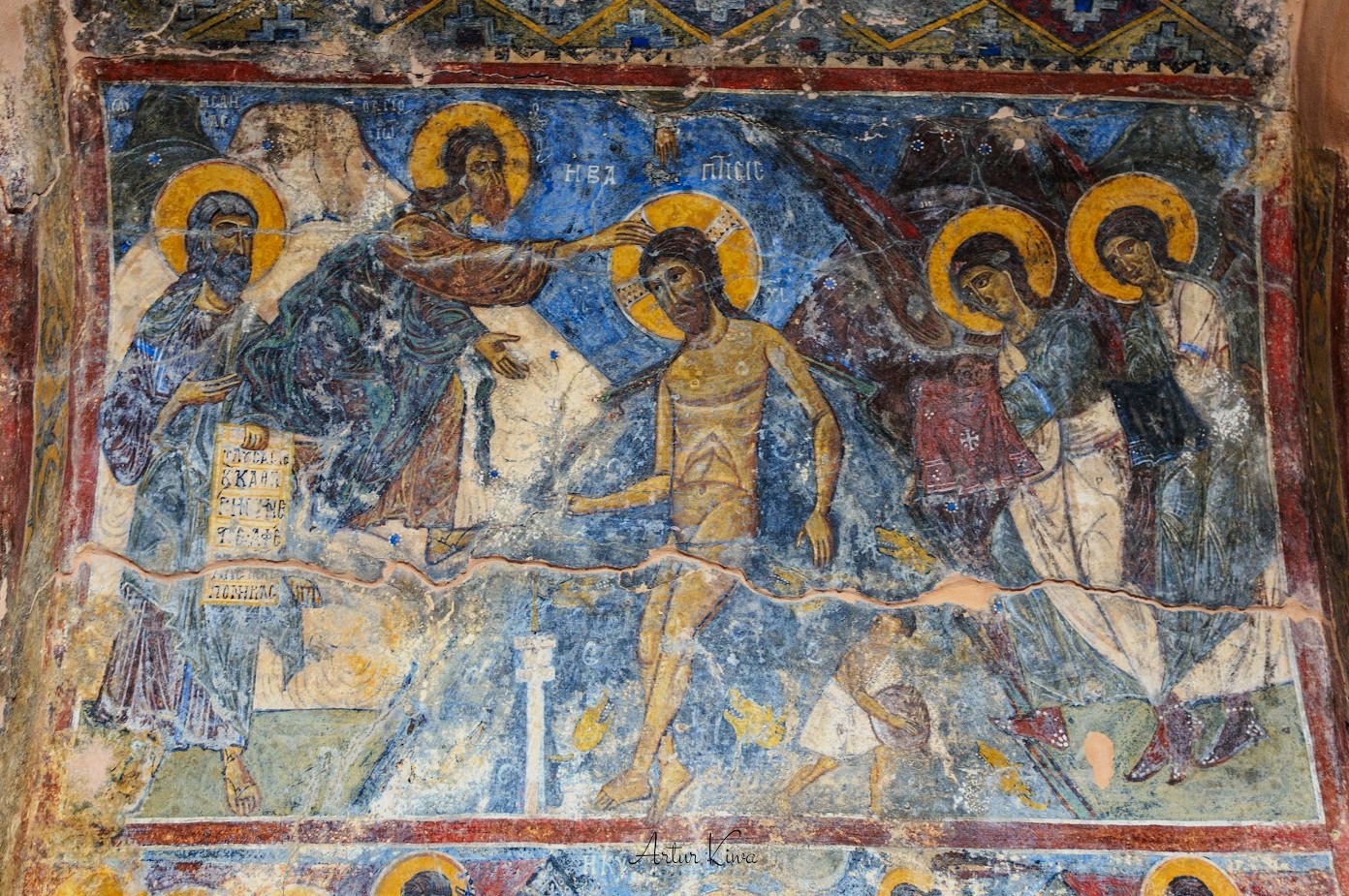
When we stand before a fresco of the Baptism of the Lord, we always begin in the same place: at the very centre, where Christ stands in the waters of the Jordan. Not because this is the compositional focal point — although, of course, it is — but because the entire scene has been constructed around one sentence from the Gospel of Mark: “καὶ εὐθὺς ἀναβαίνων ἐκ τοῦ ὕδατος εἶδεν σχιζομένους τοὺς οὐρανούς” — “and immediately, coming up out of the water, he saw the heavens being torn open” (Mk 1:10).
Mark does not write that “heaven opened”. He writes that the heavens are torn apart — schizomenous. This is not a soft gesture or a poetic metaphor, but a word describing a violent rupture. The same verb will appear in Mark only once more, at the death of Christ, when the veil of the temple “is torn” (eschisthē, Mk 15:38). Iconography understands this perfectly. That is why the sky in scenes of the Baptism is never an idyllic landscape, but a fissure, a cut, a geometric opening in space. It is precisely in this wound between the earthly and the heavenly world that the whole iconographic drama begins.
Christ is half-naked — always. Byzantine painters did not do this for effect, nor out of any love of realism. This nakedness says something very specific: He enters the water not as a sinner, but as the One who, as Paul writes, “ἑαυτὸν ἐκένωσεν”, “emptied himself” (Phil 2:7). In iconography He makes no violent gesture; He does not kneel, He does not plunge into the water — He stands calmly, upright, as if not in a river, but at the very centre of matter itself. This is not accidental, but follows from the logic of the Bible: the Gospels never say that Jesus was “cleansed”. They say only that He entered the waters of the Jordan. The Christian East reads this unambiguously: it is not Christ who is touched by the water, but the water that is touched by Him. The liturgy of Theophany puts it without unnecessary subtlety: “By sanctifying the waters, you sanctify all nature.”
On the left, John bends toward Him. In every fresco you will see the same logic: John always bends down, Christ always stands upright. This is not a matter of aesthetics, but of exegesis. John himself explains this relationship when he says: “He who comes after me ranks before me” (Jn 1:27). His hand is extended, but it never resembles the gesture of a priest administering baptism. The biblical text does not suggest this either: there is no formula, no prayer, no sacramental act. There is only a gesture of indication and the sentence: “Behold, the Lamb of God” (Jn 1:29). Iconography guards this rigorously, so as not to suggest that John is “performing” anything. He only bears witness.
And then the eye naturally moves upward. In every iconography of the Baptism — every one — heaven is open. Not as a blue window, but as a luminous, often geometric form from which a ray descends. Sometimes it is single, sometimes split; sometimes it ends in a small sphere, sometimes it touches the water directly. This is not a “special effect”, but a visualization of the voice of the Father. The Gospels say clearly: the voice comes from heaven. The icon does not try to “draw” it, but shows its entry into the space of the world. In this way the scene becomes openly Trinitarian: the Father speaks, the Son stands in the waters, the Spirit descends “ὡς περιστεράν” — like a dove. The Greek text does not say that the Spirit was a dove; it says that He descends in a manner resembling the flight of a dove — calmly, without noise, without violence. The icon simplifies the metaphor, but does not betray its meaning.
Only then does the viewer begin to notice the angels on the right-hand side. Almost always on the right, rarely on the left. This is the side of glory, the liturgical side. The angels hold white towels not in order to “serve” Christ in a practical sense, but as a sign of readiness and expectation. They are an image of cosmic service. The Gospels are silent about angels at the Baptism, but iconography adds what follows from theology: if the Trinity is being revealed, heaven cannot remain passive.
With time, we begin to see more clearly and notice details that are easy to miss. The rocks on the sides of the scene are sharply broken, unnatural, almost aggressive in form. This is not an attempt at realistic landscape, but a frame for the theophany. In biblical imagination, rocks react to the presence of God: they tremble, split, give way. In this way the icon shows that revelation touches not only the human being, but the whole cosmos.
The most activity, however, takes place at the very bottom, in the waters of the Jordan. This is where the variations begin. Sometimes the water is full of fish — the simplest image of the natural world recognizing its Creator. Sometimes monsters flee from the water, recalling the psalmic images of the subjugation of chaos: “You crushed the heads of the dragons in the waters” (Ps 74:13). The Baptism of Christ is then read as a victory over primordial disorder, the same disorder that the Book of Genesis calls tehom.
There is also a more sophisticated variant: at Christ’s feet appear the personifications of the Jordan and the Sea. This is not an artistic fantasy or a “pagan addition”, but a literal visualization of Psalm 114: “The sea saw and fled; Jordan turned back.” Cretan workshops drew on different visual languages: some spoke of chaos, others of the cosmos, and still others combined both at once.
On the left bank of the scene there sometimes appears an almost imperceptible detail: an axe laid at the root of a tree. This echoes the full, sharp statement of John the Baptist: “Even now the axe is laid to the root of the trees. Every tree therefore that does not bear good fruit is cut down and thrown into the fire” (Mt 3:10). Theophany is not only a revelation of glory here; it also carries within it the announcement of judgment. That is why this motif appears rarely, cautiously, but consistently.
There are also frescoes in which Isaiah stands beside John with a scroll and the words: “The voice of one crying in the wilderness” (Is 40:3). In such compositions, the scene ceases to be an episode from the Gospel and becomes a condensed catechesis in which prophecy, witness and fulfilment meet in a single image.
So when we look at the iconography of the Baptism, we are not looking at “baptism” in a narrative sense. We are looking at theology condensed into an image: Christ sanctifying matter; the Spirit descending; the Father speaking; John bearing witness; the angels waiting; the rocks trembling; the waters giving way.
All of this together creates not a little Gospel scene, but an icon of new creation. The Baptism of Christ is not merely the beginning of His public ministry here, but the moment in which the world is ordered anew — and that is why every detail, from the torn heavens to a single fleeing fish, has its place, its source and its history.
Bibliography
Iconography and Theology of the Image
Ouspensky, Leonid, and Vladimir Lossky. The Meaning of Icons. Crestwood, NY: St. Vladimir's Seminary Press, 1982. Sendler, Egon. The Icon: Image of the Invisible. Elements of Theology, Aesthetics and Technique. Translated by Steven Bigham. Redondo Beach, CA: Oakwood Publications, 1988. Jensen, Robin Margaret. Baptismal Imagery in Early Christianity: Ritual, Visual, and Theological Dimensions. Grand Rapids: Baker Academic, 2012.
Eastern Theology of Baptism
Schmemann, Alexander. Of Water and the Spirit: A Liturgical Study of Baptism. Crestwood, NY: St. Vladimir's Seminary Press, 1974.
Biblical Exegesis
Marcus, Joel. Mark 1–8: A New Translation with Introduction and Commentary. New York: Doubleday, 2000.
Philosophy of the Icon
Florensky, Pavel. Iconostasis. Translated by Donald Sheehan and Olga Andrejev. Crestwood, NY: St. Vladimir's Seminary Press, 1996.