26 May 2026
Zoodochos Pigi, Alikianos. The Life-Giving Spring among the orchards
Amid the citrus groves of the Chania plain stands a church that does not announce itself from a distance. You need to know what you are looking for. It is worth the effort — beneath its floor lie children, on its walls lives John the Stranger, and the dedication to the Life-Giving Spring carries a weight here that it carries nowhere else.
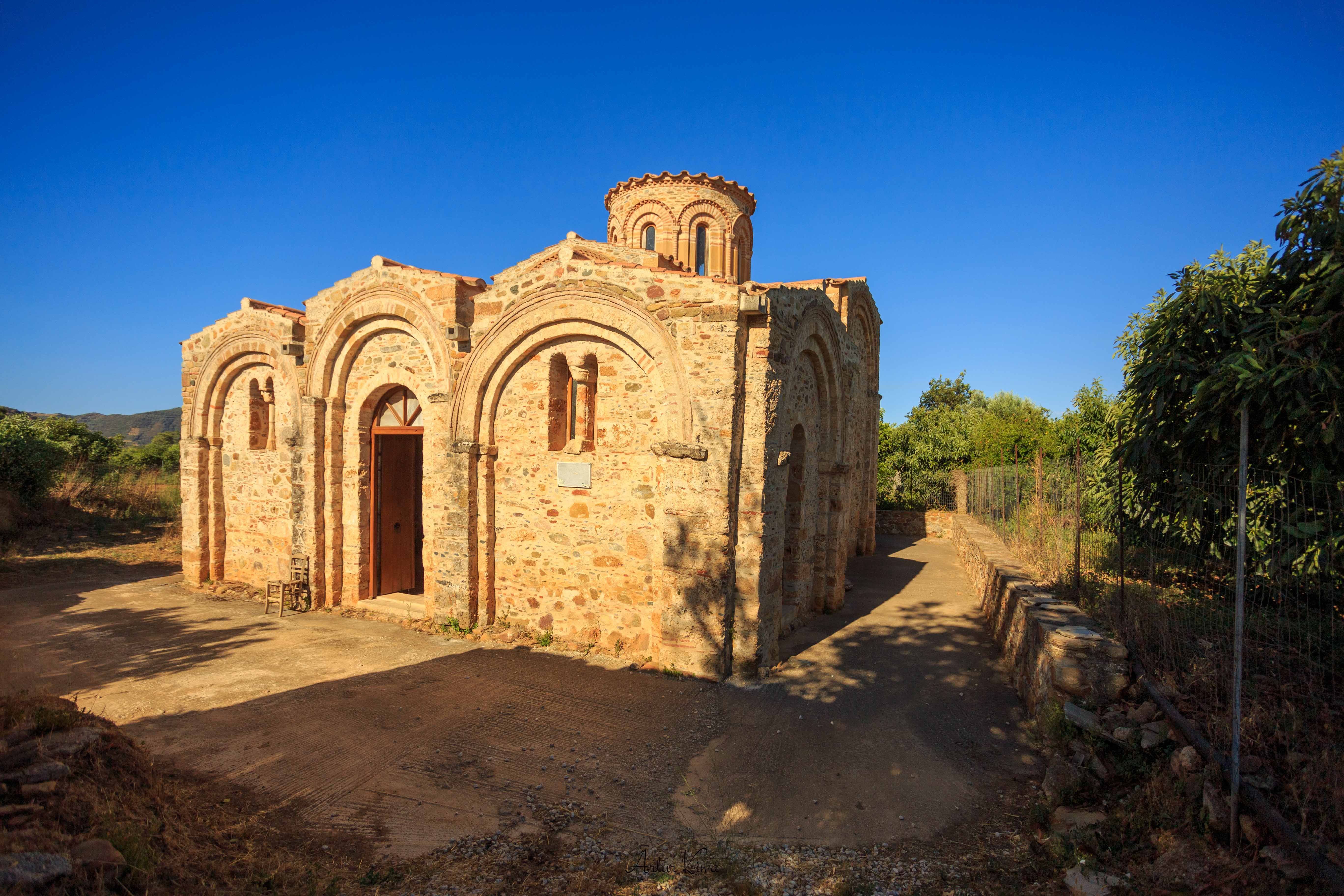
Between Alikianos and Koufos, among the citrus orchards of the Chania plain, stands one of those churches that do not shout from a distance. You need to know what you are looking for. It is worth the effort, because the Church of the Zoodochos Pigi is no ordinary village chapel. It is one of the significant Byzantine monuments of western Crete — a church connected to Saint John the Stranger, a monk, hermit and founder whose activity left a strong mark on this part of the island.
Locals also know this church as Ai kyr-Giannis, from the name of John the Stranger. According to hagiographic tradition, the church was founded around 1030, in the Middle Byzantine period, shortly after Crete returned to Byzantine rule following the Arab occupation. This context matters: we are not simply talking about a religious building, but about a sign of the rebuilding of Christian presence on the island.
Architecture
Architecturally, the church belongs to the cross-in-square type with a dome. There is no need to turn this into a lecture on architectural history — it is enough to walk into the building and see that this is no simple chapel. The plan has a clear cruciform rhythm, with a dome over the centre, and the lateral arms of the cross project markedly beyond the main mass. On the east side are three apses connected to the liturgical space: the sanctuary, the prothesis and the diakonikon. Particularly interesting is the pentagonal apse with its architectural decoration, niches and blind arcading. The walls employ techniques typical of refined Byzantine construction, including the recessed brick system and the incising of plaster to imitate regular stonework.
Outside, the later elements deserve attention — especially the south-western entrance with its pointed arch, probably rebuilt in the fifteenth century. There the traces of a third layer of painting survive: images of hierarchs, monks, probably John the Stranger himself, and the Virgin as Zoodochos Pigi — the Life-Giving Spring. A fine motif: Mary as a source of life, not in abstract theology, but on the wall of a church standing among fields and orchards.
Frescoes
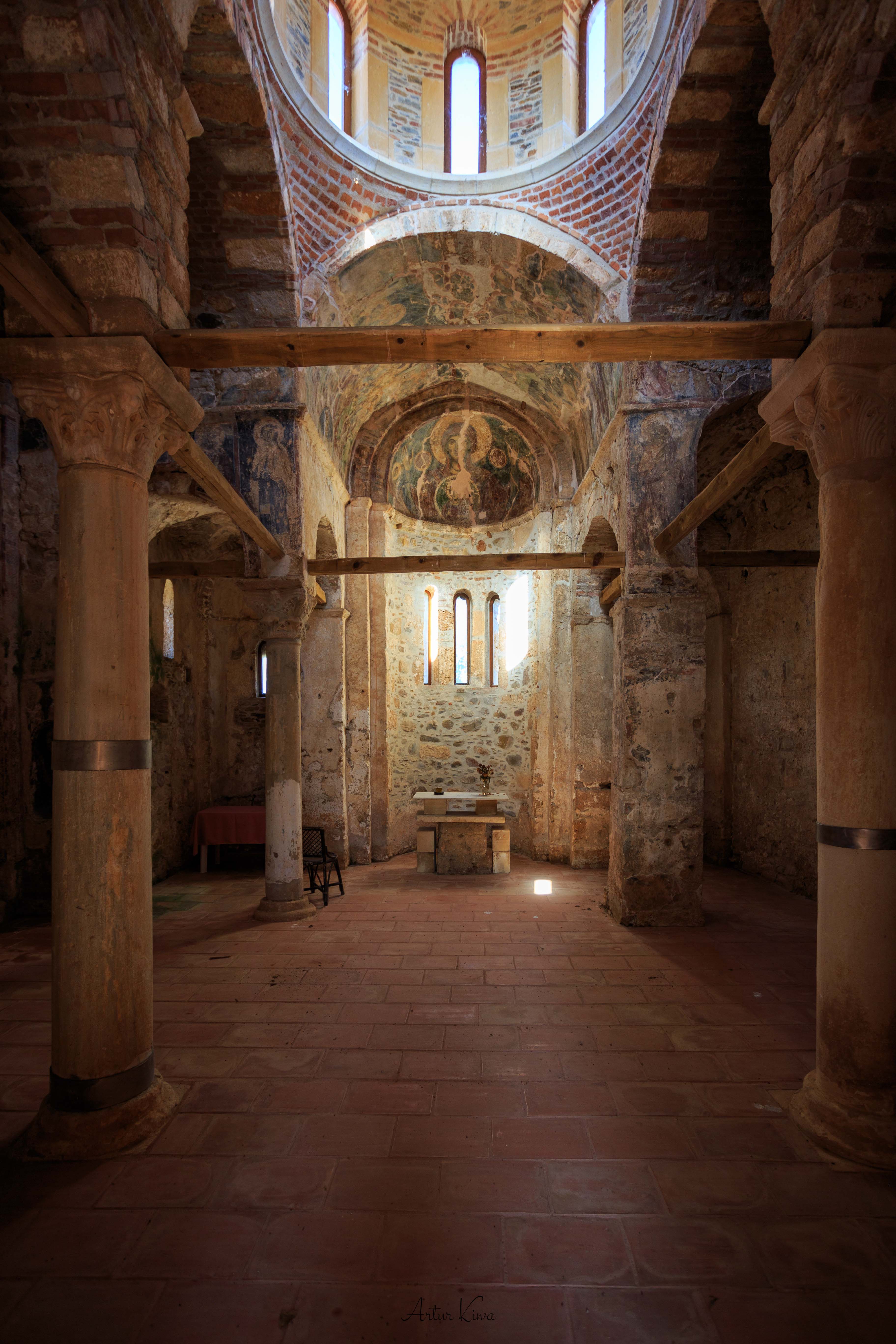
The interior preserves two layers of frescoes. The earlier dates from the eleventh century and was uncovered only during conservation work. Its condition is not ideal, but the very existence of such early painting is striking. Among the figures visible there are holy unmercenary healers — saints who in Byzantine religious imagination united faith, body, illness and the hope of cure. The second layer dates from the first half of the fourteenth century. Here a richer programme appears: the Panagia Platytera in the apse, standing and bust-length saints, Gospel scenes, and a particularly important image of John the Stranger among his disciples.
It is precisely this scene that gives the church its particular weight. We are not simply looking at anonymous wall decoration. We are seeing a local community's memory of a man who was bound to this place. John the Stranger is not a figure from a distant legend floating somewhere in the air. He is present in the space of his own foundation, among his disciples, in a place that survived ruin, rebuilding, a cemetery, oblivion and conservation.
The cemetery beneath the floor
One of the most striking things about this place has nothing to do with the architecture or the frescoes — it concerns the ground beneath and around the church. Archaeological investigations revealed an extensive Middle Byzantine cemetery in use from the eleventh to the twelfth century, with burials continuing into modern times. The children's graves are especially significant. They were found both inside the church and around it. Some of the graves contained jewellery: bracelets, earrings, necklace beads, elements of clothing.
This is a detail that can stop you more completely than any date in a catalogue. The church suddenly ceases to be simply a monument. It becomes a place of human grief, care and hope.
Anthropological analyses identified high infant and child mortality, particularly in early childhood, along with traces of disease and nutritional deficiency. Byzantium is not only golden icons, domes and imperial theology. It is also mothers, fathers, children, illness, funerals and small ornaments placed in a grave — a last gesture of love for someone who left too soon.
Conservation history
The church stood in serious ruin for a long period. Local residents first tried to preserve it; later, around 1950, restoration work was carried out by Anastasios Orlandos — the foremost Greek historian of Byzantine architecture of his day. More complete conservation work was not undertaken until the early twenty-first century. The dome was reconstructed, among other elements, on the basis of surviving architectural remains and by analogy with the church of Saint Demetrios in the Rethymno region.
How to look at it
This is a place best visited slowly. First from outside: the proportions of the mass, the apse, the traces of rebuilding, the material of the walls. Then inside: the frescoes, their layers, the figures of saints, the scene of John the Stranger with his disciples. And at the end it is worth pausing to remember that beneath your feet and around the church there was, for centuries, a space of burial. This church was a centre of religious life, but also a place of memory for the dead.
Zoodochos Pigi — the Life-Giving Spring. It is hard to imagine a better dedication for a place where life and death lay side by side for so long.
Notes for visitors
The most important thing here is not one good photograph, but several layers of history placed one on top of another. The church was founded around 1030, has frescoes from the eleventh and fourteenth centuries, later painted traces on the exterior, a Gothicising entrance from the fifteenth century, and beneath and around it a cemetery was discovered with the graves of children and adults.
It is especially worth remembering the figure of Saint John the Stranger. He is not simply a patron in name. According to tradition he was the founder of the church, and his image with his disciples survives in the fourteenth-century fresco layer. This gives the church a very personal character — it is bound to a specific person and his activity in western Crete.
The dedication Zoodochos Pigi refers to the Virgin as a source of life and spiritual healing. In the context of the children's graves discovered here, that title gains additional force. It is no longer simply a liturgical formula, but a name that resonates deeply with the history of this particular place.
The architecture too is worth attention. This is not a simple single-nave chapel, of which Crete has hundreds. It is a cross-in-square domed church, more complex in plan, with refined treatment of the walls and apse. The building itself announces that we are dealing with a foundation of considerable importance.
Bibliography
Children's burials and the cemetery
Bourbou, Chryssi. "Οι παιδικές ταφές στο ναό της Ζωοδόχου Πηγής (Αλικιανός): Ταφικές πρακτικές και ανθρωπολογικά δεδομένα." In Αρχαιολογικό Έργο Κρήτης 2: Πρακτικά της 2ης Συνάντησης, Ρέθυμνο, 26–28 Νοεμβρίου 2010, edited by Michalis Andrianakis, Petroula Varthalitou, and Iris Tzachili, 586–594. Rethymno: Εκδόσεις Φιλοσοφικής Σχολής Πανεπιστημίου Κρήτης, 2012.
Architecture and monument context
Andrianakis, Michalis G., and Kostas D. Giapitsoglou. Χριστιανικά μνημεία της Κρήτης. Edited by Kostas D. Giapitsoglou. Text edited by Manolis S. Patedakis. Heraklion: Συνοδική Επιτροπή Θρησκευτικού Τουρισμού της Εκκλησίας Κρήτης / Μ.Κ.Ο. Φιλοξενία, 2012.